Product
One capture flow. Five kinds of inspection.
The driver always does the same thing: press, walk, pause, sign. What changes underneath is the list of things that must be on camera, the rules the frames are judged against, and the report that comes out.
Pre-trip
The daily DVIR, from one walkaround
The driver covers 5 views of the truck, and after each round the app says which of them it could not see. The frames are checked against §392.7 for vehicle condition and against the general securement rules, because §392.9(b) makes the securement look part of every pre-trip.
What the video is asked to show
- Cab interior / windshield visibility
- Left side of the tractor (wheels, tires, lights, reflectors)
- Right side of the tractor (wheels, tires, lights, reflectors)
- Front (coupling, hoses, lights, fifth wheel area)
- Rear (doors, lights, ICC bumper, tailgate)
The DVIR is split in two, and the split is the point
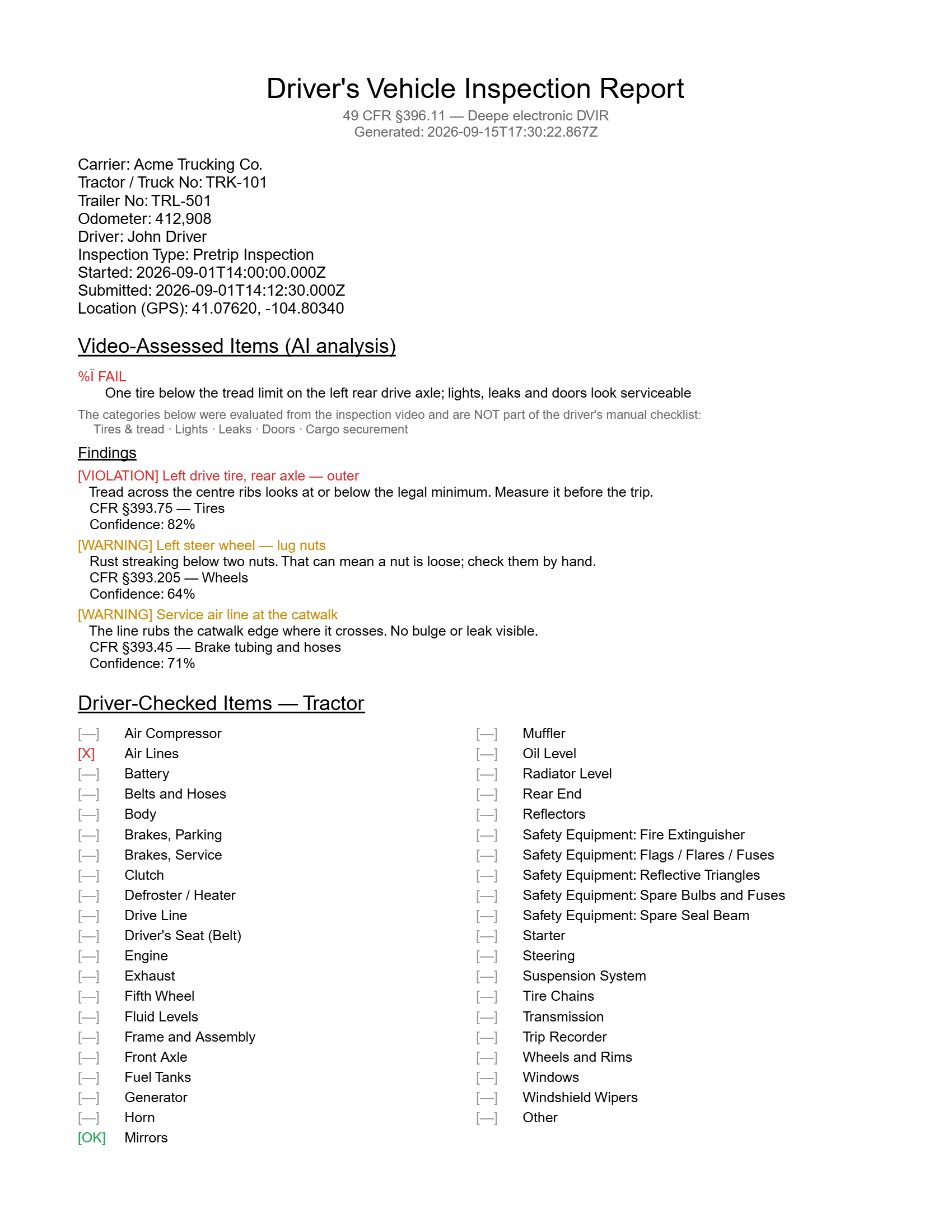
5 categories are assessed from the video and shown read-only, backed by the findings — the driver never re-approves them as a checkbox:
- Tires & tread. Tread condition, cuts, bulges and obvious underinflation — tractor and trailer (paper form: Tires)
- Lights. Head/stop, tail/dash and turn indicators, tractor and trailer (paper form: Lights, Lights - All)
- Leaks. Visible oil, coolant, fuel or air leaks
- Doors. Door condition and operation, cab and trailer (paper form: Doors)
- Cargo securement. Tie-downs, chains, load distribution, tarps and tailgate (§392.9, §393.100–393.136; paper form: Straps, Tarpaulin)
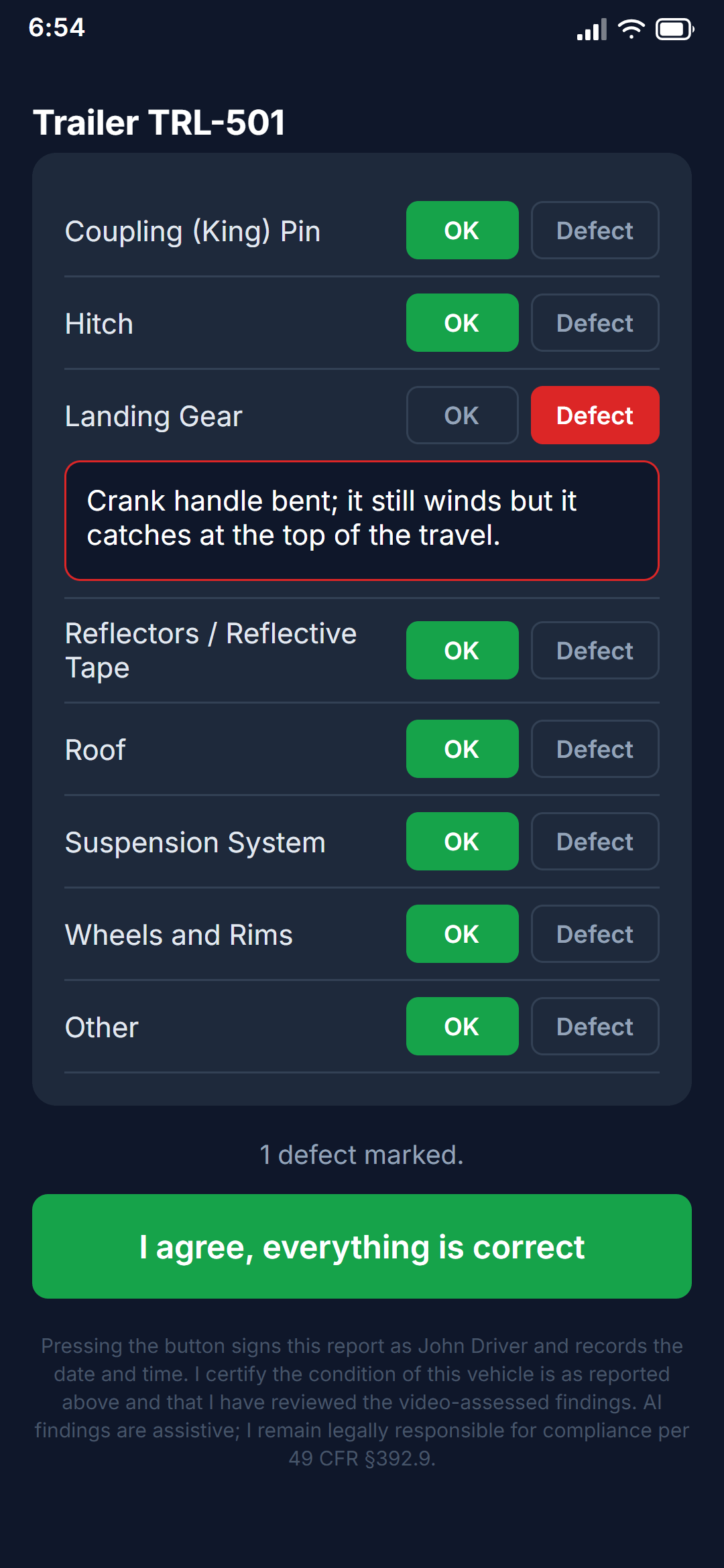
Everything video cannot judge — 41 tractor items and 11 trailer items such as brakes, steering, horn, fluid levels and whether the fifth wheel is actually locked — is a checklist the driver marks by hand. A defect needs a remark; a violation needs an acknowledgment; then one tap to sign.
Cargo check
A securement report, not a DVIR
A cargo check records what the frames show, position by position: the device, how many, whether it is right, and why. Recommendations are kept apart from violations and say so. Four kinds, each with its own list.
Open deck
Flatbed, step deck, RGN, lowboy. Every securement position is observed, working-load-limit tags are read where legible, and the §393.110 tiedown minimum and the §393.106(d) aggregate rule are computed in code from the model's estimates — labelled estimated or read, and a shortfall from estimates is a warning, never a violation.
On camera
- Overall view of the whole load
- Left side full length
- Right side full length
- Front securement points
- Rear securement points
- Close-up of every tiedown at its tensioner/binder
- Edge protection where straps cross edges
- WLL tags/markings where visible
Open deck, tarped
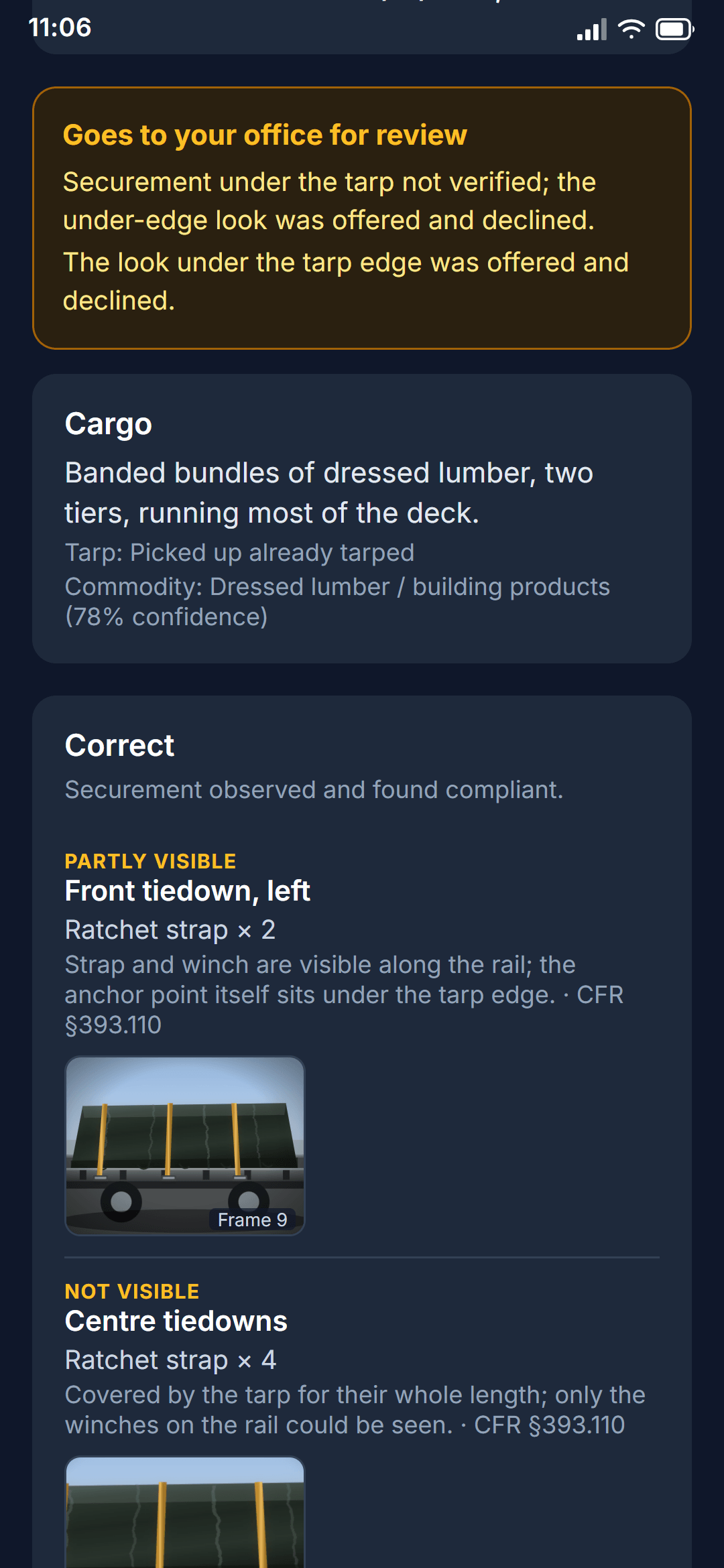
Tarped by the driver: one inspection in two stages, securement first, then the tarp, and the second stage cannot start until the first is complete because that evidence can never be recaptured. Picked up already tarped: the app offers a look under the tarp edge, records the answer as given (or as not given), and what stays hidden is exactly one warning with the reason printed on the report.
On camera
- Front of the tarp (wind entry, overlap, front flap)
- Rear of the tarp (flap folded and secured)
- Left side along the rub rail — every bungee / strap row hooked
- Right side along the rub rail — every bungee / strap row hooked
- Top of the tarp where visible without climbing
- Every strap over the tarp with its tensioner
- Tail lights, reflectors and licence plate not covered
Enclosed
Dry van or reefer, judged from the open rear doors: load locks and straps, whether they bear on the load, the floor and bracing. What is behind the rear face is written as not determinable from frames, never inferred.
On camera
- Rear doors open with the load visible
- Load overview from the rear
- Each load lock / rear strap
- Floor and bracing at the rear
Sealed
The cargo is not analysed. The seal number is read off the seal without the model ever seeing what the driver typed; the comparison is made in code with a confidence gate, and a reading below 75 % is not even offered to the driver. The seal's integrity and the latch are checked.
On camera
- Seal close-up with the number legible
- Door latch / seal hasp showing the seal is intact
Trailer as cargo (power-only)
The trailer being pulled is the load and is not in your fleet. A trailer-only pre-trip: brakes, suspension, lamps, tires, frame, wheels, coupling damage, landing gear, and the annual-inspection sticker. The unit number, VIN and plate are read from the capture and confirmed by the driver at sign-off, and every identifier prints with where it came from.
On camera
- VIN plate / registration label legible
- Trailer number
- Left side
- Right side
- Front (nose, glad hands, kingpin area)
- Rear (doors, ICC bumper, lights)
- Undercarriage: brake chambers, slack adjusters, hoses, shock absorbers, hubs
- Tires
- Landing gear
- Registration document
- Annual-inspection sticker or report
En-route re-checks
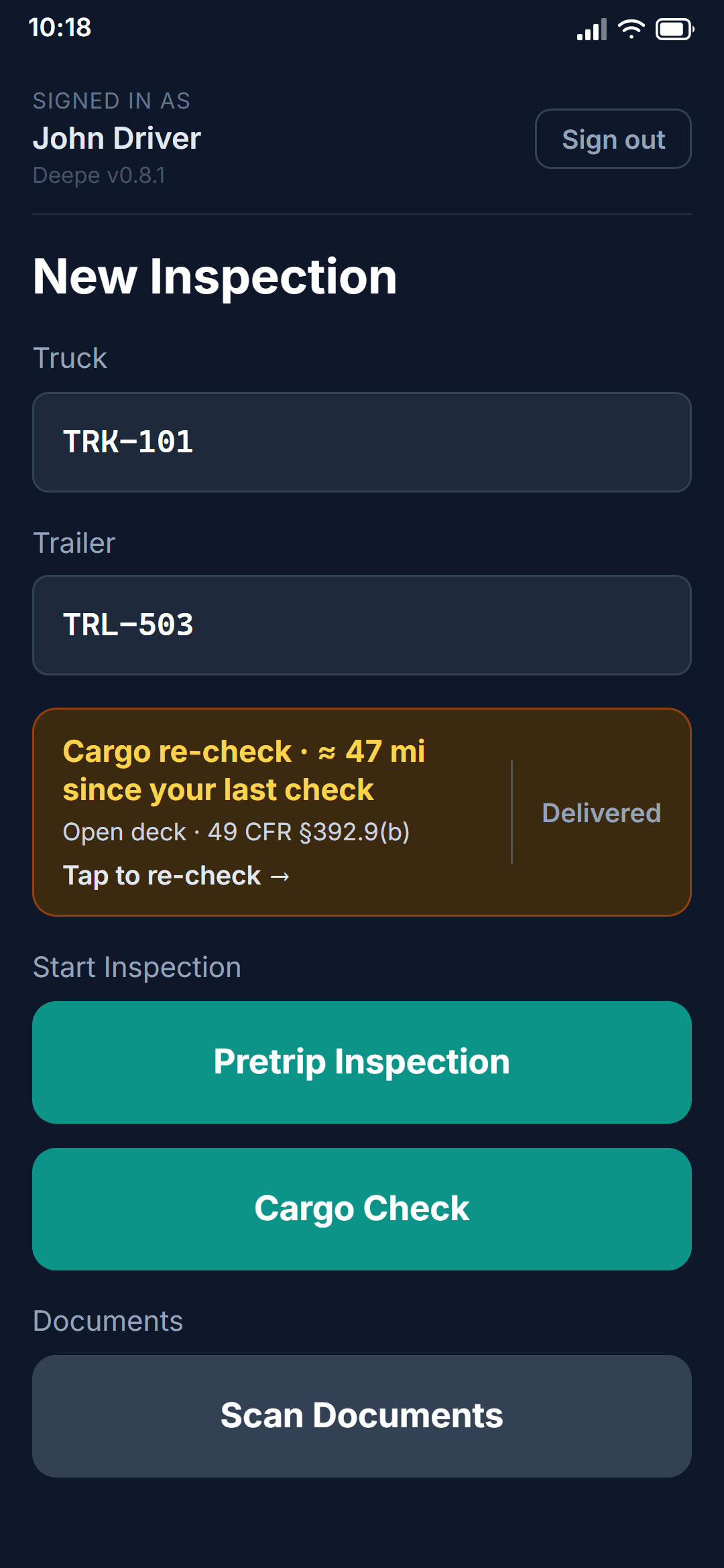
§392.9(b) makes the driver re-examine the cargo within the first 50 miles and then every 3 hours or 150 miles. Every submitted cargo check, of any kind, hangs a reminder chain: the first 60 minutes after sign-off, then every 3 hours. A re-check is a two-minute walkaround against the parent check with a short list of what can change on the road, opt-in per driver, and it ends when the driver ends it or a newer full check is submitted.
Open-deck re-check list
- Overall view of the load — has anything shifted?
- Every tiedown and its tensioner — still tight, nothing frayed
Periodic checklists
Your company’s own recurring photo checklist
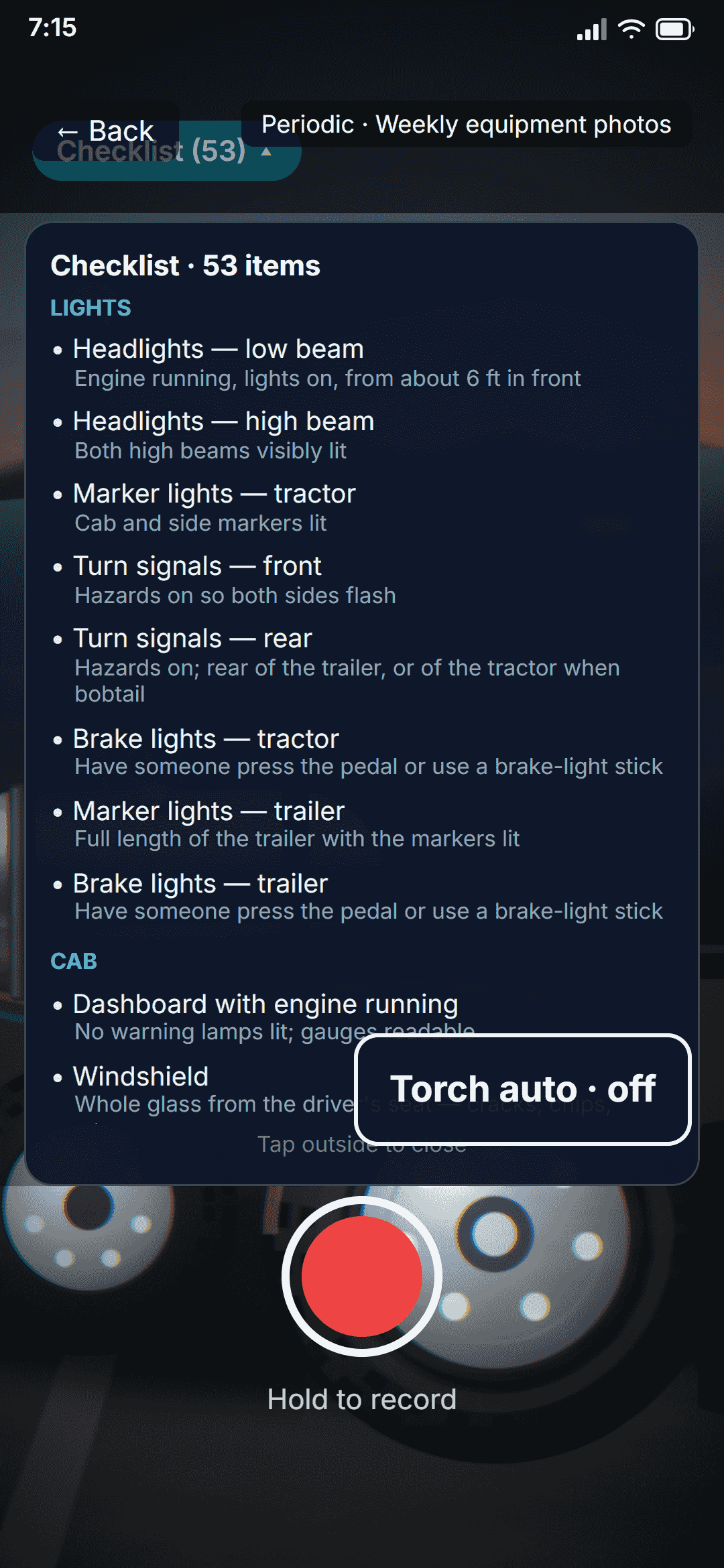
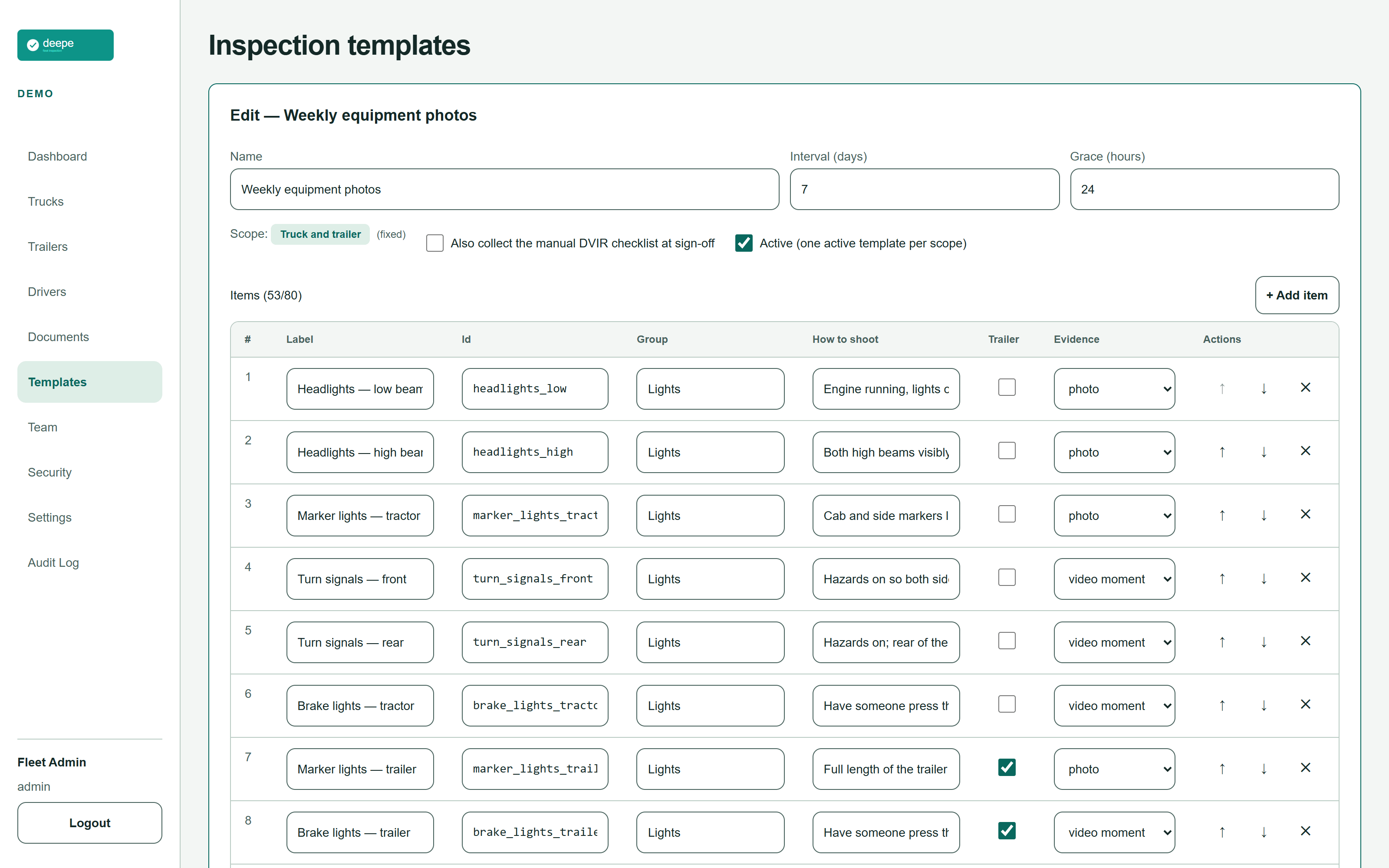
Weekly equipment photos. Monthly trailer checks. A safety manager writes the list in the dashboard — each item with a label, how it should be shot, and what counts as evidence — sets the interval and a grace period, and scopes it to trucks alone or trucks with trailers. The driver sees the list on a chip in the camera, and a “still needed” list once a round comes back short.
- Versioned. Every edit bumps the version, and an inspection is frozen against the list as it stood when it started. Later edits never change what an existing inspection is judged against.
- Every item, every frame. Unlike a pre-trip, a periodic inspection is not sampled: every frame is analysed against the checklist and each item is marked covered or not, with the frame that proves it.
- Due and overdue. The dashboard shows what is due per truck or per driver, and an alert fires once the grace period has passed.
Driver documents
Paper, scanned on the phone, kept for the record
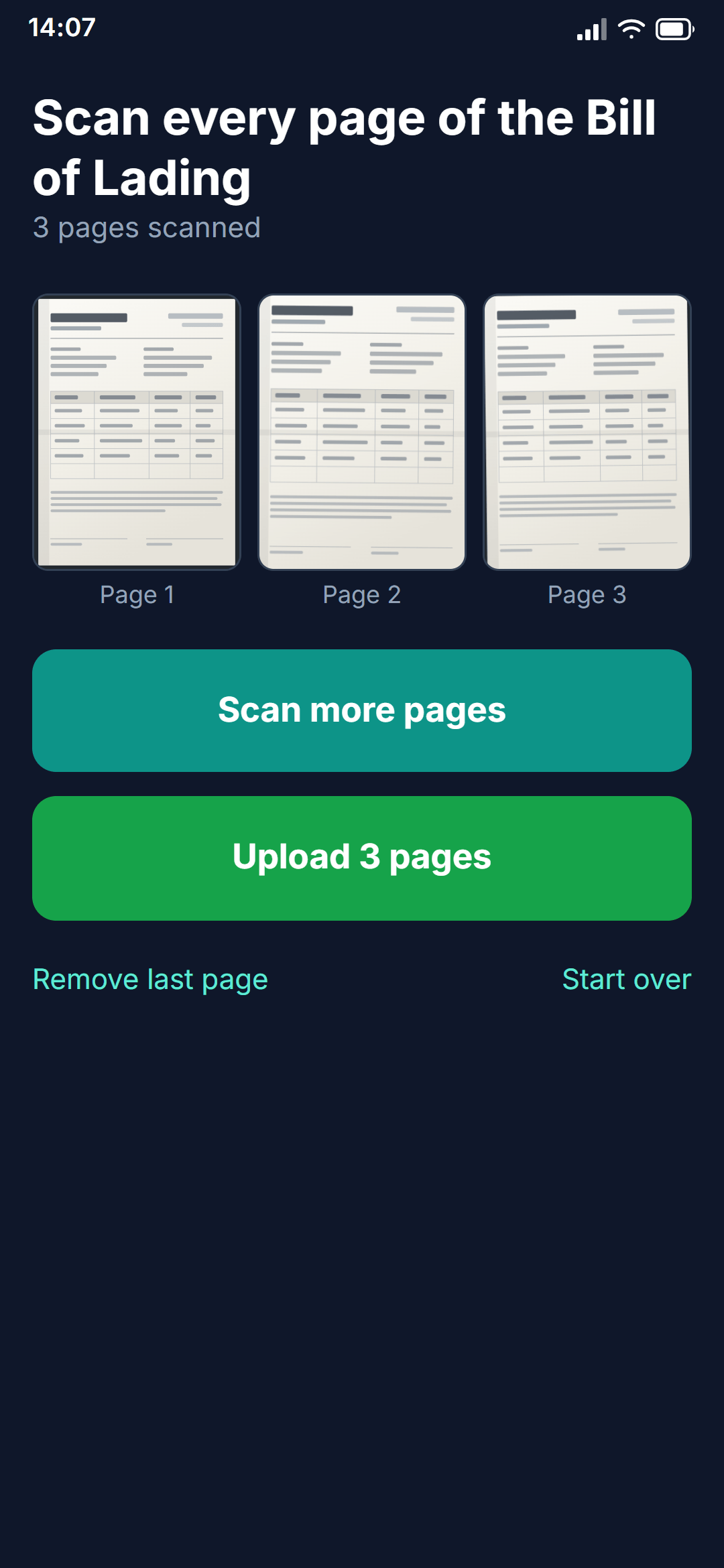
Bills of lading, roadside inspection reports, anything on paper. The phone finds the page edges, crops and straightens it, and uploads full-resolution stills. A worker enhances each page, reads it with OCR, throws out the accidental duplicate, and builds one searchable PDF/A.
- Two timestamps, on purpose. When the driver scanned it and when the carrier received it are stored separately, because §396.9(d)(3) makes delivering a roadside report to the carrier a duty with a deadline.
- Retention minimums. Roadside inspection reports are kept at least 12 months, bills of lading at least a year. Nothing deletes a document automatically, and deletion by an admin is soft and reversible.
Every rule above is written down, section by section, on the regulation map.
Open the regulation map